The Oxford Handbook of International Security (Oxford Handbooks of International Relations) by Alexandra Gheciu & William C. Wohlforth
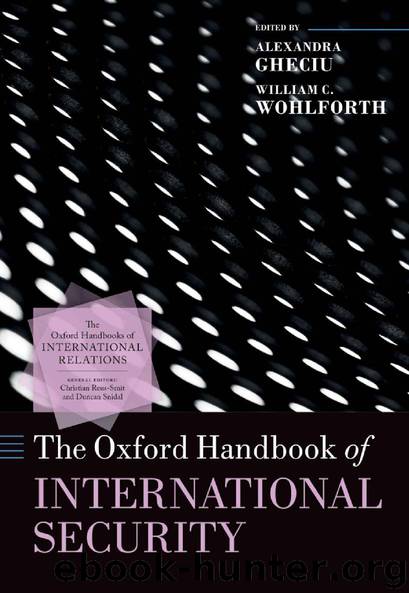
Author:Alexandra Gheciu & William C. Wohlforth
Language: eng
Format: epub, azw3
Publisher: OUP Oxford
Published: 2018-03-07T23:00:00+00:00
NOTES
1.The regime also includes the Nuclear Suppliers Group, the Zangger Committee, the Comprehensive Test Ban Treaty, the Additional Protocol, and nuclear-weapon-free zones, among others. The IAEA Board of Governors and the UN Security Council act as enforcement mechanisms on safeguard agreements. For a comprehensive analysis of this regime, see Wan (2013) and Wan and Solingen (2017).
2.Betts (2000: 69) argued that one should be able to name at least one specific country that would have sought nuclear weapons or tested them, but refrained from doing so because of the NPT. He found none that come to mind. Egypt’s former Minister of Foreign Affairs Nabil Fahmy argued that very few non-nuclear weapons states joined the treaty because it responded to their immediate security concerns and that most did so for political or economic reasons and had otherwise no reason to pursue nuclear weapons (Carnegie Endowment Conference 2006).
3.Schelling (1976: 80) himself made clear that “the most severe inhibitions are undoubtedly those on the actual use of nuclear weapons, not on the possession of them.”
4.According to Mueller and Schmidt (2010) 36 states are known to have once started nuclear weapons activities.
5.On “myth-making” and nuclear weapons, see Lavoy (1993).
6.The more inward-looking the target, the less effective are coercion and positive inducements (Solingen 2012). See also Miller (2014).
7.Pierre Gallois, Herman Khan, and Nixon himself were among them. A 1957 National Intelligence Estimate advanced that Japan was highly likely to go nuclear within a decade <http://nsarchive.gwu.edu/NSAEBB/NSAEBB155/>. Kissinger argued that “We must have no illusion: Failure to resolve the North Korean nuclear threat in a clear-cut way will sooner or later lead to the nuclear armament of Japan—regardless of assurances each side offers the other” (Kissinger 2003).
8.All references to Makoto in Endicott (1975: 63).
9.http://www.nytimes.com/2016/11/16/opinion/the-trump-effect-on-tokyo.html? ref=world.
10.Following North Korea’s launching of nuclear-capable missiles unto Japan’s exclusive economic zone in 2016, defense minister Inada Tomomi discounted Japan’s consideration of nuclear weapons “at the moment” while declaring that Japan’s constitution has “no restrictions on the types of weapons that Japan can possess as the minimum necessary.” Premier Abe immediately added that “there is no way that Japan will either possess nuclear weapons or consider possessing such arms” <https://nuclear-news.net/2016/08/07/abe-rules-out-possibility-that-japan-will-possess-nuclear-weapons/>. Nearly 60 percent of polled South Koreans arguably supported an indigenous nuclear deterrent in 2016 but the government restated its non-nuclear course <http://www.koreatimes.co.kr/www/news/nation/2016/09/205_214598.html.
11.On how non-falsifiable predictions undermine the quality of professional discourse and our ability to improve policy, see Tetlock and Scoblic (2015).
Download
The Oxford Handbook of International Security (Oxford Handbooks of International Relations) by Alexandra Gheciu & William C. Wohlforth.azw3
This site does not store any files on its server. We only index and link to content provided by other sites. Please contact the content providers to delete copyright contents if any and email us, we'll remove relevant links or contents immediately.
The Secret History by Donna Tartt(19028)
The Social Justice Warrior Handbook by Lisa De Pasquale(12182)
Thirteen Reasons Why by Jay Asher(8883)
This Is How You Lose Her by Junot Diaz(6872)
Weapons of Math Destruction by Cathy O'Neil(6261)
Zero to One by Peter Thiel(5782)
Beartown by Fredrik Backman(5734)
The Myth of the Strong Leader by Archie Brown(5491)
The Fire Next Time by James Baldwin(5423)
How Democracies Die by Steven Levitsky & Daniel Ziblatt(5211)
Promise Me, Dad by Joe Biden(5139)
Stone's Rules by Roger Stone(5078)
A Higher Loyalty: Truth, Lies, and Leadership by James Comey(4946)
100 Deadly Skills by Clint Emerson(4911)
Rise and Kill First by Ronen Bergman(4775)
Secrecy World by Jake Bernstein(4738)
The David Icke Guide to the Global Conspiracy (and how to end it) by David Icke(4696)
The Farm by Tom Rob Smith(4500)
The Doomsday Machine by Daniel Ellsberg(4481)
